
destination

MAGNIFICENT “LION FORTRESS” EMBODIES ONE OF THE BEST-PRESERVED EXAMPLES OF ANCIENT SRI LANKAN URBAN PLANNING

Perched on a slab of rock that juts dramatically over the forests of central Sri Lanka, Sigiriya is as imposing a sight now as it must have been when it was first built by a fierce king in the fifth century A.D. Meaning “lion’s rock,” Sigiriya (designated a UNESCO world heritage site in 1982) is accessed by way of passageways cut into…

Perched on a slab of rock that juts dramatically over the forests of central Sri Lanka, Sigiriya is as imposing a sight now as it must have been when it was first built by a fierce king in the fifth century A.D. Meaning “lion’s rock,” Sigiriya (designated a UNESCO world heritage site in 1982) is accessed by way of passageways cut into…

Perched on a slab of rock that juts dramatically over the forests of central Sri Lanka, Sigiriya is as imposing a sight now as it must have been when it was first built by a fierce king in the fifth century A.D. Meaning “lion’s rock,” Sigiriya (designated a UNESCO world heritage site in 1982) is accessed by way of passageways cut into…

Perched on a slab of rock that juts dramatically over the forests of central Sri Lanka, Sigiriya is as imposing a sight now as it must have been when it was first built by a fierce king in the fifth century A.D. Meaning “lion’s rock,” Sigiriya (designated a UNESCO world heritage site in 1982) is accessed by way of passageways cut into the rock face between a monumental pair of lion paws.

The fortress was later swallowed by the forest, and only familiar to local villagers. Outsiders used knowledge of its past, preserved in Buddhist texts, to search for the ancient site. British historians rediscovered its astonishing buildings and frescoes in the 19th century.

Kingdom to colony

Sigiriya was built by the fifth-century king Kashyapa I, who ruled the native Sinhalese dynasty, the Moriya. The imposing fortress was the capital of the Sinhalese kingdom until Kashyapa was defeated in A.D. 495.

After Kashyapa, dynasties rose and fell, their fortunes shaped by internal power struggles and conflicts between native Sinhalese and outside invaders from India.

The Mahavamsa, a fifth-century Sri Lankan epic, tells how the Indian prince Vijaya was the grandson of a lion. He traveled to the island of Sri Lanka and married Princess Kuveni. From their union was born the Sinhalese race (sinhala means “of lions”). In the Sinhalese tradition, the lion is the mythical ancestor of kings and a symbol of royal authority. The photograph shows what remains of the monumental Lion Paws Gate at Sigiriya.

Various cities held the status of capital after Sigiriya, such as Polonnaruwa. By the 12th century, however, overall control of Sri Lanka progressively weakened. Sinhalese power retreated to the southwest of the island, abandoning the Rajarata region, and the former administrative centers, including Sigiriya, started to fall into disuse.

Sri Lanka’s position in the Indian Ocean made it vulnerable to Europeans looking to expand their control in the region. By the mid-1500s the Portuguese had thoroughly exploited dynastic tensions in Sri Lanka’s ruling elite and controlled much of the island.

A century later the Dutch had replaced the Portuguese as colonial masters, and they were in turn displaced by the British in the late 1700s. By 1815 the Kingdom of Kandy, the last independent, native state on the island, became part of the British Empire.

The design of the garden on the western esplanade at Sigiriya contrasts rigid rectilinear lines with the rounded natural forms of the surrounding greenery.

Knowledge is power

British imperial rule brought civil servant George Turnour to the island. An aristocrat, scholar, and passionate historian, Turnour worked with a Buddhist monk to translate an ancient fifth-century chronicle, the Mahavamsa, from the Sri Lankan Pali language into English. Based on this and other texts, he identified two ancient capitals: Anuradhapura and Polonnaruwa.

Turnour also studied a later chronicle of Sri Lankan history, the Culavamsa, which told the story of King Kashyapa. In the late fifth century, this Sinhalese prince killed his father, King Dhatusena, and seized the throne, usurping his brother, who fled to India. Fearing reprisals, he built the fortress Sigiriya—but in vain: His brother returned, defeating Kashyapa, and Sigiriya lost its brief status as capital.

The 40-foot-high Avukana Buddha in Sri Lanka was carved in the fifth century, the same period in which nearby Sigiriya was built.

In 1827 a Scottish officer, Jonathan Forbes, became friends with Turnour, and on hearing the story of Kashyapa and his palace, decided to look for it. In 1831 he set off to where locals told him he would find the remains of an ancient city.

His memoir, Eleven Years in Ceylon, describes “the rock of Sigiri, . . . frowning defiance over the scanty fields and the far-extending forest of the surrounding plain.” As he approached, he could see platforms and galleries carved into the rock. Two of his party managed to scramble some way up but dislodged rocks, “which crashed among the boughs of the trees at a great depth below.”

Unsure as to whether he had found the Sigiriya mentioned in the Buddhist texts, Forbes abandoned the expedition. Revisiting a few years later, he traced the moat that surrounds the gardens at the foot of the rock but did not attempt to climb the cliff face. He doubted that the name Sigiriya was related to lions, as he had seen nothing to support that etymology.

Fabulous frescoes

British mountaineers eventually reached the top in 1851, but the task of surveying the site fell to the Archaeological Commissioner of Ceylon, Harry C.P. Bell. His survey at the end of the 19th century has formed the basis of all studies since.

ON EARTH OR IN HEAVEN?

Graffiti left by medieval travelers to Sigiriya are responses to the site’s extraordinary rock paintings depicting beautiful women dancing and bearing offerings. One notes: “The caress of the gentle breeze was delicate upon their bodies, illuminated by the light of the m…Read More

Bell painstakingly ascertained the layout of Kashyapa’s fantastical city as well as detailed the magnificent carving of the lion’s paws at the entrance, which Forbes had not been able to see.

In addition to the elaborate water gardens at the foot of the rock, Bell’s survey also lavished attention on the galleries on the rock face. These are decorated with exquisite wall paintings that have become some of the most prized objects in Sri Lanka’s artistic heritage. A total of 21 surviving frescoes may depict apsaras, celestial singers and dancers.

Nearby, also on the walls of the rock face, are well over 1,000 items of graffiti, scratched by monks and pilgrims who visited the site in the eighth to the 13th centuries. These messages from the past can cause a frisson when read by visitors today. One reads: “At Sigiriya, of abundant splendor, situated on the island of [Sri Lanka] we saw, in happy mood, the rock that captivates the mind of all people who come here.”
Perched on a slab of rock that juts dramatically over the forests of central Sri Lanka, Sigiriya is as imposing a sight now as it must have been when it was first built by a fierce king in the fifth century A.D. Meaning “lion’s rock,” Sigiriya (designated a UNESCO world heritage site in 1982) is accessed by way of passageways cut into…

Perched on a slab of rock that juts dramatically over the forests of central Sri Lanka, Sigiriya is as imposing a sight now as it must have been when it was first built by a fierce king in the fifth century A.D. Meaning “lion’s rock,” Sigiriya (designated a UNESCO world heritage site in 1982) is accessed by way of passageways cut into…

POPULAR TOURIST DESTINATIONS IN SRI LANKA RIGTHT NOW

From ancient cities and kingdom to jungles and sandy beaches, here are few of the special places that present opportunities to celebrate travel at its finest.

Sigiriya

The 5th-century monolithic rock citadel and UNESCO World Heritage Site built during the time of King Kasyapa. This magnificent fortress embodies one of the best-preserved examples of…

From ancient cities and kingdom to jungles and sandy beaches, here are few of the special places that present opportunities to celebrate travel at its finest.

Sigiriya

The 5th-century monolithic rock citadel and UNESCO World Heritage Site built during the time of King Kasyapa. This magnificent fortress embodies one of the best-preserved examples of…

From ancient cities and kingdom to jungles and sandy beaches, here are few of the special places that present opportunities to celebrate travel at its finest.

Sigiriya

The 5th-century monolithic rock citadel and UNESCO World Heritage Site built during the time of King Kasyapa. This magnificent fortress embodies one of the best-preserved examples of…

From ancient cities and kingdom to jungles and sandy beaches, here are few of the special places that present opportunities to celebrate travel at its finest.

Sigiriya

The 5th-century monolithic rock citadel and UNESCO World Heritage Site built during the time of King Kasyapa. This magnificent fortress embodies one of the best-preserved examples of ancient Sri Lankan urban planning and irrigation hidden amidst a tropical forest. Its rock carvings specially the gigantic section of what remains of the ‘Lion Paws’ and beautiful rock painting frescos preserved from the elements for over a millennium in a cave have become some of the most iconic showcases of national artistic heritage in Sri Lanka. The Rock Palace at the summit is a miniature city of its own and today the landscaped gardens of Sigiriya are the oldest surviving in Asia and among the oldest in the world. 

Kandy

The last kingdom of Sri Lanka, home to the temple of the tooth relic of Lord Buddha. Kandy is a UNESCO world heritage site which houses the most important Buddhist artefact in Sri Lanka: historically, it has played an important role in local politics due to the belief that whoever holds the relic is responsible for the governance of the country. Upon entering the temple, witness a cultural performance before proceeding to navigate the hallowed hallways of the palace.

Witnessing a cultural pageant in the months of July and August showcasing traditional dancers, drums and elephants, shopping for rare gems and jewelry, antiques and wood carvings, visiting royal botanical gardens are among the major excursions, tourists like to be part of in Kandy.

Mirissa

Nestled in tip of Weligama bay, the long lost Surf Shangri La for beginners and pros alike Mirissa is a hotspot for whale and dolphin watching. Visit secret beach, a small secluded beach tucked around the corner from the main beach, if you get there early enough you just might have it to yourself.

Ella

A charming town surrounded by breathtaking mountain views, Ella is a great place for adventurous souls, offering many popular spots to hike or trek: summit Mini Adam’s Peak or Ella Rock to witness a stunning sunrise, then visit the architectural wonder that is the Demodara Nine Arch Bridge and see a train pass which is always a delight even better when experienced at sunrise. Ravana falls is a mere 10 minutes from Ella township, which will not disappoint! It also hosts an amazing zipline experience stretching at 500m which will let you reach speeds of up to 80km/h.

Galle

In Galle, the Dutch Fort is a must-see, originally built by the Portuguese and conquered by the Dutch in the 17th century, today it is a UNESCO World Heritage sitealong with the adjoining Dutch hospital precinct that is now home to chic restaurants, cafes and boutique shops. 

Stroll along bluestone paved roads, visit a museum, peruse some jewelry and other trinkets, grab some gelato at a cafe or restaurant, take in the view of the ocean from the ramparts… there’s something for everyone!

Ahangama

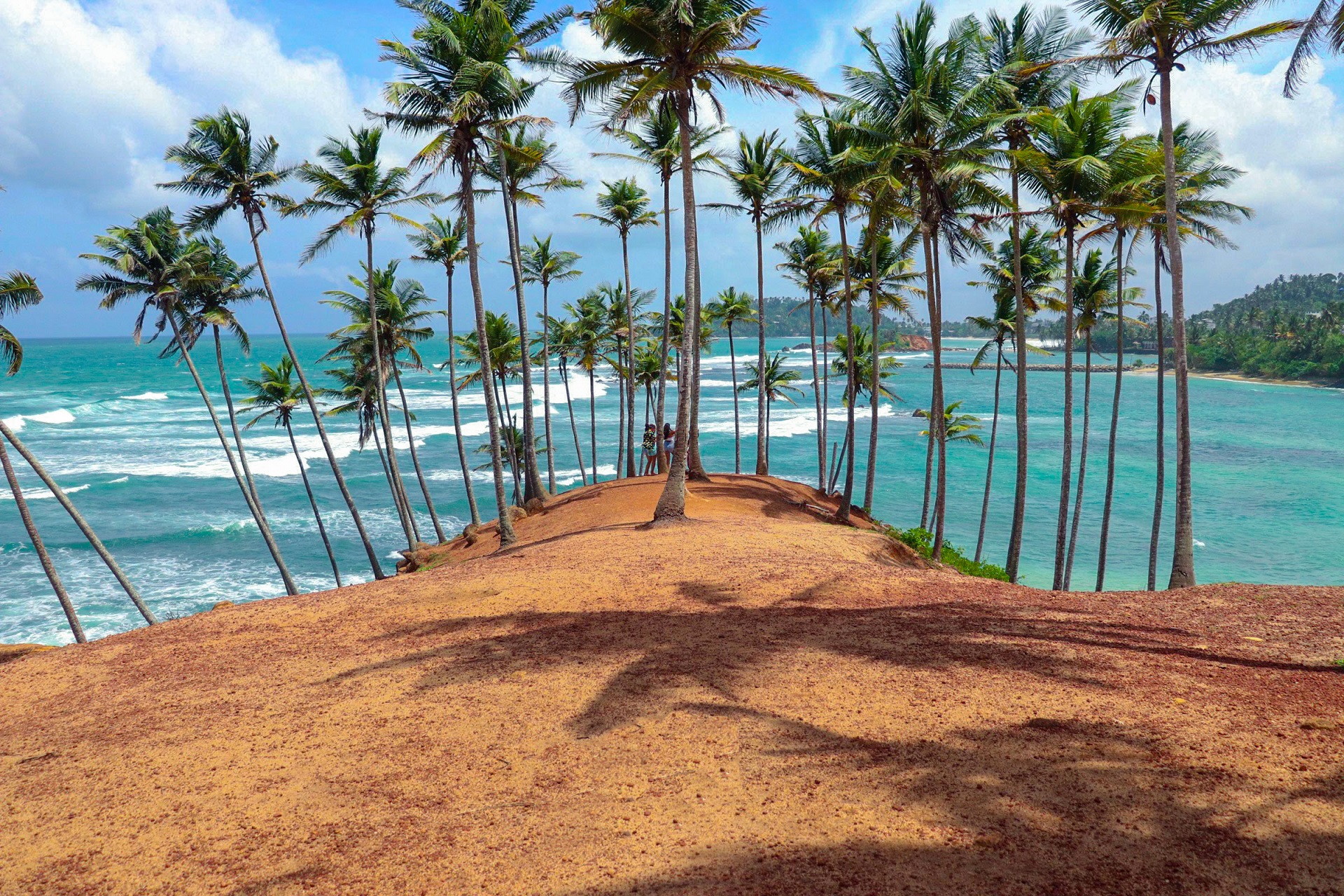
A southern beach town where the only sounds you’ll hear are the waves hitting the shore and the palm trees swaying – is the ideal location for a serene and picturesque getaway.

You can do everything from taking up yoga or surfing, enjoying Ayurveda or wellness treatments, visiting turtle hatcheries or tea estate, and even learning or experience stilt fishing!

Hiriketiya Bay

A south bound surfing haven surrounded by quirky cafes and bars – is the perfect spot for a fun yet relaxing vacation under the island sun.

The best time to visit is between November and March when the waves and warmth are just right. The food and beverages with a local twist remain fantatstic around the year, of course!

Arugam Bay

Considered the surf capital of Sri Lanka, Arugam Bay is a world famous destination with breaks for Surfers of all skill levels complemented by Yoga lessons and mediation, Ayurveda and wellness spots, Beach parties and the well known hippie market.

Visit  Kumana National Park, a hidden delight of Sri Lanka hosting a very special eco system of wildlife and stunning scenery on the eastern coast of the island.

From ancient cities and kingdom to jungles and sandy beaches, here are few of the special places that present opportunities to celebrate travel at its finest.

Sigiriya

The 5th-century monolithic rock citadel and UNESCO World Heritage Site built during the time of King Kasyapa. This magnificent fortress embodies one of the best-preserved examples of…

From ancient cities and kingdom to jungles and sandy beaches, here are few of the special places that present opportunities to celebrate travel at its finest.

Sigiriya

The 5th-century monolithic rock citadel and UNESCO World Heritage Site built during the time of King Kasyapa. This magnificent fortress embodies one of the best-preserved examples of…

Translate »